|
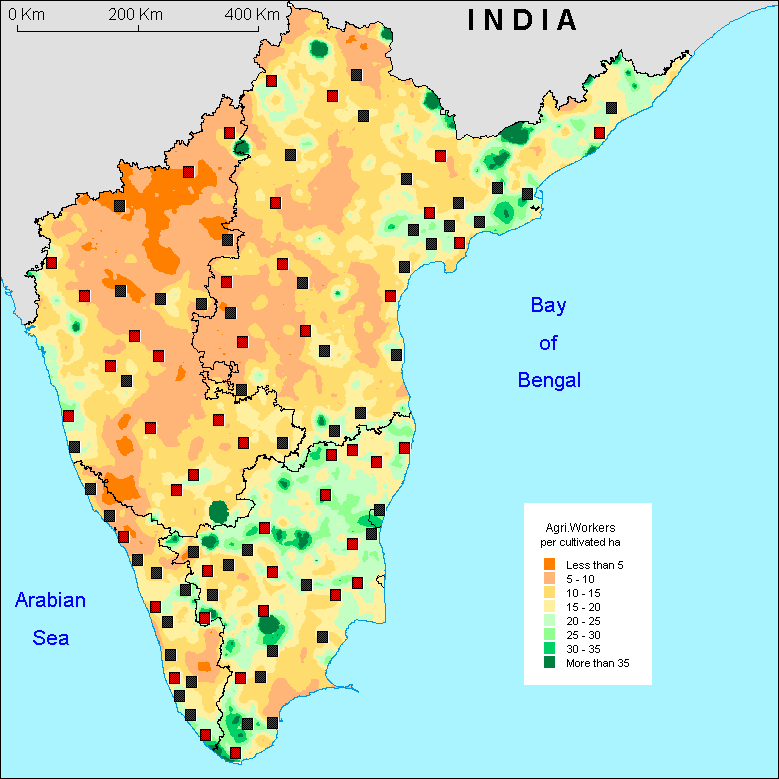
This
map shows the level of pressure on land, which is a rare asset
in a country suffering from a high population density jointly
with a low rural economic diversification. It is not possible,
however, to deduce from the percentage of agricultural workers
the level of regional rural poverty, since two other factors
intervene. First, the dynamics of the non-agricultural economy
which can relieve at least partly the pressure on land; second,
the level of cropping intensity (number of crops per year) allowed
by irrigation.
Out
of the four States, one has a high ratio of agricultural workers,
namely Tamil Nadu. Another one has a generally low ratio, namely
Karnataka. On the whole, deltas (Godavari, Kaveri) and large
command areas explain a great deal of the high ratios thanks
to irrigation. On the contrary, a semi-arid environment often
implies low ratios (northern Karnataka, Rayalaseema). Note that
there are some exceptions. Some areas have a comparatively rather
low ratio in spite of irrigation, such as the Kaveri delta:
it is not a mark of rural wealth, however, but rather a proof
that irrigation is not efficient for bringing high yields and
high cropping intensity. Plantation areas (Kerala) also have
a rather low ratio, which proves their low labour intensity
(note the discrepancy between the Karnataka and Kerala littorals,
which is rarely to be seen on other maps). Conversely, some
areas suffer from a rather high ratio without clear sufficient
resources (borders of South Karnataka and North Andhra Pradesh,
Dharmapuri district in Tamil Nadu, etc.).
There
is no relation with the presence/absence of cities, which leads
to the assumption that the first possible factor of land pressure
relief (economic diversification) is much less important than
the second one (cropping intensity), except in a few regions
such as coastal Karnataka.
F.L.
|