|
Karnataka,
located mainly on the Deccan Plateau, is the less irrigated
state in South India, with the most arid climate (rainfall is
lower than 800 mm per annum), except for the coast and the Ghats
which are well watered (2 500 mm/year).
The
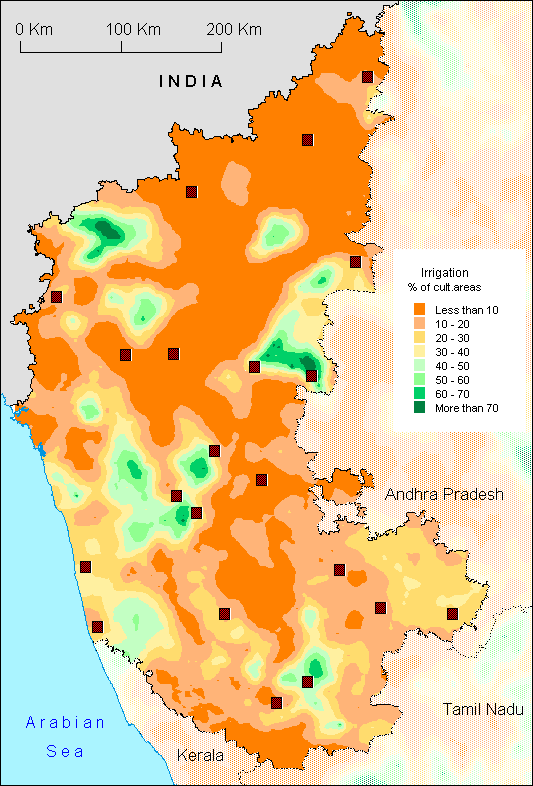
densely irrigated zones (green spots on the map) result all,
in Karnataka, from large dams, built for the majority since
1950, and from long perennial canals that distribute water to
wide areas. Thus, close to Belgaum, in the South of Bijapur
and close to Hospet, one can see the influence of, respectively,
the dams called Hidkal (see for example the site [waterresources.kar.nic.in/belgaum.htm]
presenting the various dams of Belgaum district), Narayampur
and Tungabhadra. The canals on left and right bank of Tungabhadra,
built in 1963, are among the longest of South India, measuring
226 and 349 km (it is surprising besides that the percentage
of irrigated lands does not form a continuous zone along these
canals). Close to Shimoga, several dams were built, explaining
the scattering of irrigated lands. In the South, along Cauvery,
the irrigated zones mainly depend on the dam Krishna Raja Sagar
built at the time of the maharaja of Mysore (1932).
A
clear difference is observed between the drier North of Karnataka
which depends essentially on a rainfed agriculture and the South
where the famous Indian "tanks" are very numerous. A tank (kere
in Kannada, eri in Tamil, gantu in Telugu) is a technique, many
centuries old, which consists in a storage-reservoir dammed
up on three sides, supplied either by run-off and rainwater,
or by the surplus of tanks located upstream, or by a canal which
derives water from a river. A tank stores water only during
4 to 6 months of the year, which limits the irrigation to this
period. However, it has the advantage of recharging the aquifers.
The size of the tanks is variable - from a few hectares to 40
sq km - but the majority can be managed on a village scale.
In Karnataka, most of the 40 000 tanks are small, of a surface
lower than 20 hectares.
O.A.
|